


The type of assessment you have for PIP or the WCA makes little material difference to the outcome, according to a trial involving over 350,000 randomly assigned assessments covering face-to-face, telephone and video. The most striking difference was that PIP claimants who switched from one assessment type to another had higher average award rates and received higher monetary awards.
The trial took place between May 2022 and January 2023. Award rates were adjusted to take account of mandatory reconsiderations and appeals where applicable, with 97% of PIP claimants and 96% of WCA claimants having had a final decision by March 2025.
The trial only included people having an initial PIP assessment or WCA who were considered able to use all three assessment channels. Existing benefit recipients and people for whom one or more channels were considered unsuitable were not included.
The results showed little material difference between the assessment channels
For PIP, the final award rates were 50.1% for claimants allocated a face-to-face assessment, 50.4% for video and 49.2% for telephone. The difference between face-to-face and telephone was statistically significant, but the DWP says the effect was very small.
PIP claimants allocated a remote assessment also received a slightly lower average weekly award than those allocated a face-to-face assessment. When disallowances were included, the averages were £52.11 for face-to-face, £51.38 for video and £50.75 for telephone.
However, PIP claimants who switched channels did see a difference.
Around 30% of claimants allocated to a face-to-face PIP assessment and 27% of those allocated to a video assessment attended a different type. In contrast, very few claimants allocated to a telephone assessment changed channel.
Most claimants’ preference when requesting a channel change was towards telephone.
Channel changers had higher average award rates and received higher monetary awards. This was regardless of the allocated channel and the channel the claimant attended, suggesting the channel itself is not the driver.
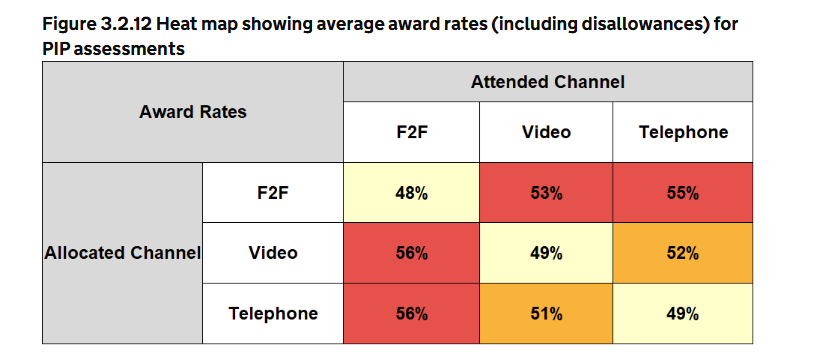
A heat map showing award rates by allocated channel and attended channel for PIP shows award rates vary from 48% to 56%. Award rates are lowest where claimants attend the same channel as allocated to them and generally higher where claimants attend a different channel.
So, claimants allocated a PIP telephone assessment who stayed with telephone had an award rate of 49%, compared to 56% for those who switched to face-to-face.
On the other hand, claimants allocated a face-to-face assessment who stayed with face-to-face had an award rate of 48%, compared to 56% for those who switched to telephone.
However, the DWP specifically warns against concluding that switching assessment type caused the higher award rates.
It says the results are likely to reflect “selection effects” – in other words, people who choose to change assessment type may differ in some way from people who do not. The DWP concludes that the assessment channel itself does not appear to be the driver of the higher awards.
There were too few WCA claimants who changed assessment channel for the DWP to carry out the same detailed analysis.
One possible explanation for the difference, Benefits and Work suspects, is that switching may be more likely amongst claimants who are more aware of the rules around assessments and better able to provide evidence, given that they understood their right to change assessment type and had the confidence to request a change.
The findings are at odds with separate statistics produced by the DWP, which show consistently lower award rates for face-to-face. They raise questions about the value of the current drive to increase the proportion of face-to-face assessments.
The results do not prove that switching assessment type increases your chances of an award or a higher award. But the results do suggest that if you consider that the type of assessment you are allocated for PIP or the WCA is not the one that you think would enable you to give the best evidence, then you should not hesitate to request a change.
You can read the full trial results here.